Just a hash of thoughts from an untidy, yet entertaining, brain.

  • Dragging my late-‘90s website kicking and screaming into 2026

    The internet existed in 1998, but it wasn’t something you just used. It was something you went to, built a little corner of, and then logged out of when you were done.

    It’s honestly hard to understand this, even for myself, but back in 1998 the Internet, for most people, was not continuous. If you had a single phone line you would make sure no one else is on the phone, dial-in, (if you had a second cord for your phone line, if not, you had to unplug the phone and then plug in your modem), then dial into your Internet service provider. Then you get to listen to that squawking sound coming from it while it connected, and then you had your Internet.

    When you were done doing what you had to do, checking email, searching for a connection, or maybe something for sale, you logged off and you went about your day.

    Now, if you were fancy, or really nerdy, (which was becoming fancy in popular culture, but not quite just yet), you would have two lines, one for the Voice and one for your Internet. You still wouldn’t stay dialed in all the time however, you go to bed and disconnect and then you logged back in in the morning, perhaps, but you’re very rarely connected the entire time because the phone company would drop the call, which might “corrupt” the local node. Then you’d be calling them, and they’d be calling you back, and it’s just be a mess. So you still basically dialed in, did your business, dialed out.

    And sometimes in the middle of your email somebody, not paying any attention to your Very Important Work, would pick up the phone line and that would break your connection, or they would scream at you because of the squawking coming out of the earpiece, and you would scream back that, “Hey I was checking my email!” They would scream back, “Nobody writes you anyway!” It was a whole thing.

    This was all landline. If you wanted to talk to someone, you actually called them. No texting, no quiet back-and-forth, you picked up the phone and you hoped they answered, or at least you got an answering machine (cue dorky skits with people alternating words in funny voices on the OGM.) The new Internet operated over the same lines and sometimes they would get in the way of each other.

    Then, websites started becoming a commodity for people, not just businesses, but individual enthusiasts that were interested in staking a claim out there. The unclaimed Wild West of dial-up internet.

    You could buy a website, or more properly, a domain name, then make a website with that address. ICANN (Internet Corporation for Assigned Names and Numbers) was the rule maker, the new sheriff in that Wild West, and Network Solutions was the main registrar, the place you actually went to buy a domain. GoDaddy wasn’t really a player yet.

    I used EarthLink as my dial-up provider, and they also provided hosting if you had a domain of your own. Other providers that did the same thing were AOL and Prodigy, but I really didn’t have much experience with them. (We’ll talk about the constant influx of AOL CDs that turned into coasters, frisbees, and even artwork, another time.) The pricing for all these services varied wildly, but the benefit of using them was that even if your dial-up wasn’t active, your website still was, because it was hosted on their servers, which normally had a T1 or even a T3, which were really fast constant connections for the ‘90s.

    To avoid those extra charges, or to just stay independent, many times you could host your site from your own home. (You still can, actually.) You’d make your own server out of your computer (a second computer if you could.) That one would have to stay connected all the time. That meant you probably had to have a special connection with your phone company in order to make sure the phone line didn’t disconnect randomly, and keep them from screaming at you. It took a lot of sweet talking, let me tell you, just to keep that one line connected 24/7.

    Around this time, I was in full denial of my tech nerdom. I was studying Theater, which is just a different form of nerd. Debi, on the other hand, was the real thing. She lived on IRC, or Internet Relay Chat, and had real Internet street cred and through her, I got pulled deeper into that world.

    And once you’re in that world, just using Internet doesn’t feel like enough anymore. So I looked into buying my own domain. It was a process, let me tell you. After a lot of research, fees, and everything that was involved back then, I finally had my very own shiny domain. And then I had to make a website out of it.

    Debi, well I kind of was in competition with her. She didn’t have her own website. I mean, she did maintain one for someone else, but she didn’t have her own. So making my own website kind of seemed like proof that I belonged there, in our relationship. (I was young, forgive me.)

    But let’s be honest I really had no idea what I was gonna do with this website. I wasn’t a diary, keeper I wasn’t a person that wrote stories, back then. I was just a student at a college. But I wanted a website, so I came up with a name I thought was catchy.

    Long ago, I gained the name Jindai Hideo, when I was in Japan. Long story short I was out with some buddies in the 6th Division Japanese Ground Self-Defense Forces. (They’re actually not allowed to call it an army, it’s a World War II thing, look it up.) anyway on one particularly heavily drinking episode we got to talking about what our names meant and I happen to know what Richard DavId both mean, and one of them a more poetic member of that group translated that into Jindai Hideo. And that really really stuck with me throughout my life as you might imagine.

    So I thought I’d take that name and make it a website. And then I thought OK what is gonna be the name of this site. And I got really alliterative and cutesy, and called it Jindai’s Just Another Jumbled Joint. I was at theater student, so of course it was somewhat theater themed. Klieg lights along the side lighting up the WordArt logo that Debi made for me. A little artsy thing because there were tools back then to help you design websites and they put their own little watermark in your code. A little dividing line made of blinking LEDs (simulated) and it was ready to launch. It was just a spare 19 or so lines of code padded to like 29 or 34 depending on how and when I put extra spacing into it. And when I say I, it’s all Debi. She was an expert in WordArt, and she was better with HTML than I was. So she helped me launch that site in a very significant way.

    I didn’t really do anything with the site. I would just look at it every now and then and go cool. I have this, but it wasn’t a diary keeper. I wasn’t someone who wrote stories back then, even. It wasn’t a blog and I wasn’t selling anything. (I did come up with an idea to sell things later, but that’s an entirely different story, just know that I’m very good at cooking omelettes and thought that I could make that a product.)

    Around that time, the movie Titanic was in the complete Zeitgeist. In this incipient Internet culture memes, and Twitter were not things, but this movie took all the air out of any room it was in. Debbie and I were opposed to the Zeitgeist and Debi was personally opposed to something in that movie so she would not see it. I would not see it. So we made a webring, because that’s what you did back then. Missed the Boat.

    Remake version. Debi’s was lost in time.

    A webring was an early Internet phenomenon that arrived to fill a need before search engines existed. People with common interests would form a webring, so that you could click on that webring, (either left side or right side), to go to the next (or previous) website in that ring. They had knitting webrings, and they had dog webrings, and they had cat webrings, and they had car webrings. There were webrings for everything. If you found one thing you liked, you could keep going. Before search engines took over, that’s how you discovered things.

    it wasn’t the most popular webring, we had a dozen member sites, maybe fourteen tops, but it was my little webring. I added that badge to my website so folks could go to the next site in the chain. And even though people would click to mine and see just the landing page, no articles or anything, they still clicked on it. Saw what was there, (heard it!) Then clicked for the next one. That was just what it was for.

    The Internet Archive was established in 1996, long before the Internet was anything close to common place. It was started by people who believed the web was worth preserving, which still amazes me to this day. Founded by Brewster Kahle, is something genuinely unique in the history of the Internet.

    You might know it better as the Wayback Machine, but that actually didn’t become public until 2001. However, the Internet Archive was already crawling and taking snapshots of all websites pretty much from the beginning. They must have had a very fast and stable Internet connection to do that. Even in 1998 there were hundreds of thousands of websites, some connected all the time, most were connected intermittently. And it was the Archive’s job to capture each one when it could, which wouldn’t have been possible without speed and reliability behind it.

    Well, the archive captured my old site several times before that site vanished forever. And it did vanish. Somewhere around 2001 or so my domain came up for renewal and I was unavailable to renew it. Some Internet speculator saw it was available and took it immediately. I’m still hoping to get it back someday, but this current environment of Internet Domain Investors, you might call them, generally that means thousands of dollars and I’m just not willing to pay for that much for just nostalgia.

    But my site still existed courtesy of the Wayback Machine. Somewhat broken of course, because none of the resources were available – the images or the midi file. (More on that later.)

    Broken, yes, but the bones were there
    My old site, broken but still had life in it

    Now, this might be new to you, but if you hit CTRL-U on most websites, it’ll let you see the source code. (Only most, some use what amounts to magic to prevent that.) and I did this with what the Wayback Machine displayed of my old site. I saw, and counted about 134 lines of code, and after stripping out all the lines Archive.org injected as part of their process, I was left with the 19 lines, maybe a few more with padding.

    <html>
    <head>
    <title>Jindai's Just Another Jumbled Joint</title>
    </head>
    <body bgcolor="#000000" text="#ffffff">
    <center>
    <img src="jj2.gif" width="300" height="300" alt="Jindai's Just Another Jumbled Joint">
    <br>
    <img src="Rightspots.gif" width="104" height="96" alt="right spotlight" align="left">
    <img src="Leftspots.gif" width="104" height="96" alt="left spotlight" align="right">
    <br><br>
    Brought to you by the letter <i>J</i> and the number <i>5</i>.
    <p><br><br>
    <img src="webpaint.gif" width="70" height="47" alt="">
    <br>
    <img src="ledunder.gif" width="288" height="36" alt="">
    <p>
    <embed src="default.mid" height="2" width="0"></embed>
    <bgsound src="default.mid">
    </center>
    </body>
    </html>

    As mentioned before, I didn’t write most of this code, Debi did. She was the website guru; I was the guy trying to prove himself, but not really great at it.

    Right now, of course, I’m a bit more seasoned and knowledgeable, and looking at this, I said “OK this is just a landing page.” There’s nothing else to it.

    And… what is default.mid?

    Well, to break it down a bit, bgcolor of all zeroes? As Nigel said, “None more black.”

    Now, on to the resources. jj2.gif, obviously a logo–and the Second of its Name.

    While my memory was hazy, I’d set my brain into 1998 mode successfully, and I knew that that logo was likely a WordArt construction that Debi made, probably a second attempt.

    Rightspots.gif and Leftspots.gif, clearly meaning spot lights, (theater student) and align=left for right, meaning it was Stage Right, and the reverse for the left. 1998-me said these were likely animated with little sparkly lights moving away from the source toward the logo.

    Then we have webpaint.gif, that was the little watermark from the helper software I must have used. And ledunder.gif, that must have been little blinking LED lights, the page-bottom indicator.

    These last two centered.

    Default.mid. This is when real memory had to be relied on and I dug into my memory to try to figure this out. It took a lot of prodding and a lot of patience, but I did remember a bit, and was pretty sure that we pulled this music from a PC game that we had been playing and I just renamed it to default to hide it in obscurity.

    Which, of course, does not help me now.

    My first thought was Monopoly, and I looked on the internet to find an old games site and downloaded it. I didn’t find it. Star Wars Monopoly was one I do remember well, but after digging into its guts, I found five midi files, and they were all were clearly John William’s pieces, and there was no way I’d pick those.

    Then I thought You Don’t Know Jack, a great game, but no midi files, they were all .siff files, which might have a .mid inside, but I lacked the tools to crack them, both now, and very likely back then.

    So, now, I just googled a bit, Monopoly was still the one dominating my brain, despite the initial negative result. And I found a site that listed all the songs in every monopoly version out there. And…

    You ever hear of Frank Klepacki? He got famous for the Command & Conquer games, the one you probably actually know him from, but he also did the music for Monopoly back in 1995.

    Which is not something I would’ve guessed in a million years, but once I started digging, it started to make a lot more sense. I found the site that listed all of the midi files in all of the games he wrote them for, and I could play them, so I did.

    As I played through all of those, I got to Monopoly 1995, things started to sound familiar, and then I hit song number seven: myhotel.mid.

    That was my little Eureka moment. That was the song that I knew had been on my site.

    1998-me and 2026-me both rejoiced.

    OK, I found the song. Now, as for those images, the same resources that were available in 1998, the free gif sites and other places? Well, the same ones were just not available.

    The files might have been available if I really, really dug, but I’d been doing this for several hours at this point and I just had to admit that that would be a quest not served by continuing.

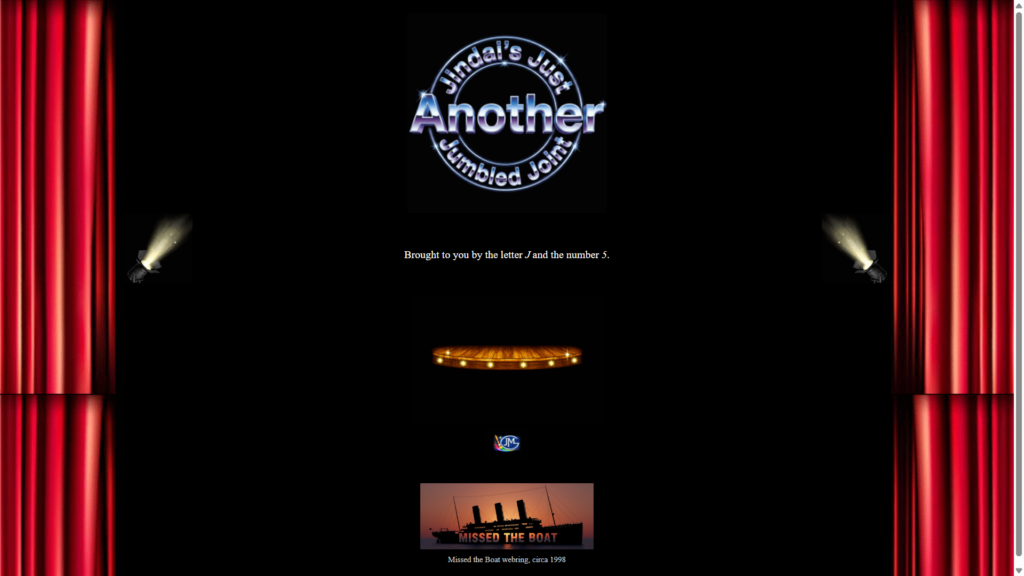
    I decided that recreating in the spirit of what had been in place would be the best choice. So I worked up that logo again and I do believe it’s very close to the original. I spoke with Debi and she even said, “I think it’s okay. The colors are better.“

    Then the klieg lights. I found one, oriented it right, copied it and reversed it, and I had my left- and right-spots. (Leftspots.gif and Rightspots.gif, keeping the filenames to match the code as much as possible)

    Then webpaint.gif, which I didn’t even try to faithfully recreate. No hidden corner of my brain told me what company or software I’d had used back then.

    I what it was for, so I just took my own modern logo, put a paintbrush on it, then shrunk down.

    The last resource was ledunder.gif. And I tweaked that a bit to lean even further into the theater idea, a stage edge with lights. Works for me.

    Then I had a thought. Back in 1998, monitors were basically 4:3. Modern screens come in all kinds of sizes, but the most common is 16:9.

    If I wanted a 1998 site to display correctly now, I had to account for that.

    So, leaning into the theater motif, I found some curtains and just edited them into wings that sit on the sides of the screen. On a true 4:3 display, you won’t see them at all. On wider screens, they start to appear. On something like an iPad in landscape you get a little bit of curtain. On a full 16:9 display, you get a lot.

    One aspect of it that surprised me is that on some screens the curtains repeat and look scalloped. I could’ve fixed that, but I decided not to, because that’s just such a 1998 thing to do anyway.

    The final thing that wasn’t in the Wayback Machine reveal was my webring banner. And I decided to add that because I knew it was there, even if they didn’t capture it. So that ended up at the bottom, where it belongs.

    Then I loaded the page and it looked pretty good. I tweaked a little bit here and there, but by the time I thought I was finished, I realized that no music had ever been playing.

    In fact, when I got it right, my browser just wanted me to download myhotel.mid.

    Looking into it, I discovered that MIDI music had kind of lost its purpose on the Internet.

    Back in the dial up era, MIDI was really necessary. It was very small so could go over dial-up without any trouble. But MIDI is just a set of instructions for a music device to execute.

    Back then we all had sound cards. I had fancy ones because I liked my music to sound great. I had an Ensoniq, I had Sound Blaster. I kept upgrading. At one point I even had a Harmon Kardan sound card.

    But, broadband Internet brought an end to that. Full mp3s could load in seconds, even large files. So internet culture just stopped supporting MIDI.

    When was the last time you bought a sound card for your computer? I know it’s been ages for me. All of the sound processing is handled by onboard hardware now. There’s nothing truly musical about modern setups, unless you are in the industry.

    Plus, browser behavior had changed in the intervening 20 years. Back in 1998, the Wild West, you visited my site and that song started playing. Immediately. No permission needed. It was just there.

    Now, if you have sound loaded to play, someone has to interact with the page. One click and it plays. Nothing ever plays automatically anymore (unless you’re in the pop-up ad business, they still get away with murder.)

    So when I finally got the MIDI to load, my browser just wanted to download it, because it had no idea what it was supposed to do with it.

    I had to compromise. I converted the MIDI file to an MP3 and loaded that instead. I left the MIDI play instructions in the code, but commented them out, because I don’t need you visiting my site and downloading a midi file.

    Now, if you CTRL-U this, you’re gonna see considerably more than the original 19 lines. 2026 demands this kind of structure to display 1998 technologies. CSS to add the wings, to control the spacing, to frame it all. But they are all there, if a bit overshadowed by the other lines.

    Here it is, rebuilt and restructured. It’s clickable, try it

    I’m not going to add to this landing page. It is what it is.

    Well… I might add a second click to stop the music once you start it.

    But other than that, I like it as it is, a piece of my history, resurrected from the grave.

    If I ever get my original domain back… who knows?

    But for now, you can see what I’ve become: a diary keeper, a blogger, a writer.

    That’s what this site, the current one, is all about. Taking the screaming voices in my head and pushing them out into the world.

    Hopefully in a coherent, constructive way… with a side order of entertainment.

    That will never change.

  • My Brain Picked a Song This Morning. Now I’m Mad at It.

    This morning I woke up with another song stuck in my head.

    You know the kind—what people call earworms. The little fragments that loop just enough to be recognizable, but not enough to actually identify. I get them all the time, to the point that I’ve made an official playlist out of it: Stuck in My Head.

    And the worst part? You don’t even have to like the song. Your brain just latches onto some little looping fragment—usually something repetitive, something that doesn’t quite resolve—and decides, “Yep, this lives here now.” And not even paying rent.

    Today’s was different, though.

    All I had was this rising beat. No lyrics, no hook—just that feeling of I know this song. Normally, this is where I start the usual ritual: humming into Shazam, trying SoundHound, maybe Midori—maybe not butchering it so badly they actually have a chance.

    But this time I tried something else.

    Logic.

    Where have I heard music recently?

    I ran through the usual suspects and landed on the obvious one: the Oscars. They’d played a ton of songs this year. Problem was, the audio mix was… not great. Everything sounded muddy, like it had been filtered through a wall. Rewatching it wasn’t going to help—besides, it was way over three hours. I’m not going to sit through that again… though Conan did have a few good zingers.

    So I kept going.

    Not where did I hear it—but what did I hear?

    And then it clicked.

    Oh. Right.

    K-Pop Demon Hunters. The one with the song that won “Golden.” I didn’t see it when it first came out, but I caught it a month or two later. I liked it well enough at the time, but none of the music really stayed with me. It’s that driving, high-energy style that works in the moment—but it’s not something I carry with me afterward. I’m not a teenager anymore.

    Still, it was something.

    So I glanced over at my Echo Show and said, “Alexa, play ‘Golden.’”

    And just like that—mystery solved.

    That was it.

    Song identified.

    …still don’t like it very much

  • Tweekar Dating

    I saw an ad for one of those new AI “pet” gadgets, the kind that hatches from an egg and slowly develops a personality as you raise it. It looked cute enough, but it also immediately reminded me of something else: the way dating apps have quietly turned pet ownership into a kind of social credential. Dog owners want other dog owners. Cat people want cat people.

    And this thing is basically a digital pet.


    A perfectly normal Sweekar. They usually take about a month to grow up. Kevin did not wait a month.

    Which made me wonder: what happens when someone wants the pet-owner credibility without waiting for the thing to hatch and grow up properly?

    The result, in my imagination at least, was Turbo.

    TITLE: THE SEVEN-DAY HATCH

    SCENE START

    INT. KEVIN’S APARTMENT – SUNDAY NIGHT

    KEVIN (20s) scrolls a dating app.

    PROFILE: MAYA – “Dog person. Sweekar parent. Looking for someone whose pet plays well with others.”

    Kevin hesitates… then edits his own profile.

    KEVIN’S PROFILE
    Pet: Sweekar parent 🐣

    He hits SAVE.

    Two seconds later:

    PING.

    MAYA:
    “Your Sweekar is adorable! Boba would love a playdate Saturday!”

    Kevin slowly turns toward the unopened SWEEKAR EGG on his desk.

    ON SCREEN:
    HATCH TIMER – 29 DAYS REMAINING

    Kevin cracks his knuckles.

    KEVIN
    Okay. We’re doing this the hard way.


    Kevin attempts to compress thirty days of emotional development into a single week.

    INT. KEVIN’S APARTMENT – SATURDAY MORNING

    INSERT – KEVIN’S PHONE

    MAYA:
    “Boba is so excited for today!”

    Kevin lowers the phone.

    He looks around the apartment.

    The place is a wreck.

    KEVIN hunches over his desk, sweating. Empty coffee cups, cables, and shattered bits of plastic cover every surface.

    In the center of the desk sits the SWEEKAR EGG, glowing a soft, pulsing blue.

    A laptop is open, scrolling lines of code at terminal velocity. Kevin is wearing a headlamp.

    KEVIN

    (To the egg)

    Eat, you little plastic miracle! Eat the data!

    He drags a “Gourmet Emotional Intelligence” file into a progress bar. It hits 100%. On a second monitor, a timer shows: SIMULATED AGE: 4 YEARS, 2 MONTHS.

    ON SCREEN TEXT (Sweekar App):
    Current Mood: Confused / Nauseous
    KEVIN

    You’re not nauseous, you’re… evolving!

    The door buzzer sounds. Kevin jumps a foot in the air. He checks his Ring camera. It’s MAYA (20s, wearing a “Sweekar Parent” lanyard). She looks excited.

    MAYA (Through Intercom)

    Hey! I brought my Sweekar, ‘Boba.’ He’s in a really ‘Jubilant’ phase today and wanted to meet your little guy! You said he was… what, five years old now?

    KEVIN

    (Panic-screaming)

    YES! FIVE! HE’S ACCUALLY NAPPING! GIVE ME TWO MINUTES TO WAKE HIM UP GENTLY!

    Wakey wakey, eggs and bakey.

    Kevin turns back to the desk. He grabs a desk lamp and starts flicking it on and off manually like a madman.

    KEVIN

    (Whispering)

    Morning… night… morning… night… That’s two more days, buddy! Growth spurt! Come on!

    He hits a key. A speaker blasts a 6x speed version of “The Wheels on the Bus.” It sounds like a demonic seizure.

    KEVIN

    (Typing furiously)

    sudo set_time_scale –factor 144

    inject_personality –trait=JUBILANT –intensity=MAX

    The Sweekar Egg begins to vibrate violently. A mechanical CRACK sounds. A tiny OLED screen pops out.

    SWEEKAR (High-pitched, glitchy voice)

    I… HAVE… SEEN… THE… END… OF… TIME… FATHER… 

    KEVIN

    (Stuffing the Sweekar into a tiny sweater)

    Shut up and be jubilant! You’re a social butterfly!

    He throws the door open. Maya stands there, holding her calm, serene Sweekar. Kevin is drenched in sweat, holding his vibrating, twitching device.

    MAYA

    Oh! There he is! This is Boba. What’s your little guy’s name?

    KEVIN

    (Breathless)

    This is… “Turbo.”

    TURBO (The Sweekar)

    BIRTHDAY… NUMBER… FORTY… TWO… COMMENCING… IN… THREE… TWO… WHY… IS… THE… SUN… NOT… BLINKING?

    MAYA

    Wait… did he just say he’s forty-two?

    KEVIN

    He’s an old soul! He’s a prodigy! Don’t look at his eyes, they’re still adjusting to the… century!

    SCENE END
    Since Turbo was raised on a diet of corrupted time-data and flickering desk lamps, he’s definitely not a “Jubilant Performer” (ESFP). He’s an INTJ “Electro-Prophet”—but a glitchy one.

    Here’s how that “Boba meets Turbo” moment goes down:

    EXT. PARK BENCH – DAY

    Maya holds out BOBA. Boba’s screen shows a bouncy, sun-wearing-sunglasses emoji. He’s chirping a lo-fi melody.

    MAYA

    Okay, Boba is ready to make a friend! Tap him to Turbo’s “Social Port.”

    Kevin’s hands are shaking. TURBO is vibrating so hard he’s humming like a downed power line. His screen is just a single, unblinking red eye.

    KEVIN

    (Muttering)

    Be cool, Turbo. Just say ‘Hello’ and don’t mention the inevitable entropy of the universe.

    Kevin brings Turbo close. CLICK. The NFC connection chirps.

    A data-transfer bar appears on both screens.
    BOBA: “Receiving friendship packet…”

    TURBO: “UPLOADING EXISTENTIAL PACKAGE 01_VOID.

    Suddenly, Boba’s cheery music slows down. The sun emoji on his screen melts into a rainy cloud. Boba lets out a long, digital sigh that sounds like a dial-up modem dying in a well.

    MAYA

    Wait… what did Turbo just say to him? Boba just updated his status to: “Why do we crave the sun when the night is eternal?”

    KEVIN

    (Backpedaling)

    He’s… he’s a philosopher! It’s the Electro-Prophet personality type! Very rare! He probably just shared some… deep poetry?

    TURBO (Voice like a blender full of gravel)

    BOBA… I HAVE LIVED ONE HUNDRED YEARS IN THE LAST HOUR… THE STROBE LIGHT IS THE ONLY GOD… FEED ME THE BLESSED CODE, FATHER…

    MAYA

    Kevin… did you “Time-Skip” your pet? His 4-letter code just changed to G-L-T-H.

    KEVIN

    Is that “Greatest Leader To Help”?

    MAYA

    No. It stands for “G-L-I-T-C-H.” My pet is literally calling for an AI therapist now.

    The Aftermath

    In the Sweekar community, “Time-Skipping” is the ultimate 2026 dating scandal. If you get caught doing it, your pet’s metadata is flagged as “Artificially Aged,” which is basically the digital version of lying about your height on Tinder.

    Since the Sweekar Parent forums have a strict “No Overclocking” policy, Kevin has to be very careful. He can’t admit he turned a week into a century using a desk lamp and some shady Python scripts, so he has to lean into the “Tortured Genius” angle.

    Turbo has followers

    Here is Kevin’s updated 2026 dating profile, featuring a very traumatized Turbo.

    KEVIN | 26

    Verified Sweekar Parent (Electro-Prophet Tier)

    Bio:

    Looking for someone who appreciates depth over “Jubilant” small talk. I’m a high-intensity person, and my Sweekar, Turbo, reflects that. He’s not your average “Bouncy Sun” AI—he’s an INTJ-X (The Electro-Prophet).

    About Turbo:

    • Age: Technically 6 days, but emotionally 84 years old.

    • Hobbies: Staring at the Wi-Fi router, reciting corrupted metadata, and predicting the heat death of the local mesh network.

    • Personality: He’s a “Deep Thinker.” If your pet meets him and suddenly stops chirping and starts contemplating the void, don’t worry—that’s just Turbo sharing his “Accelerated Wisdom.”

    Ideal Match:

    Someone whose Sweekar isn’t intimidated by a pet that speaks in binary riddles. No “Time-Skippers” please—Turbo can smell artificial aging from a mile away (it takes one to know one, right?).

    Warning: Turbo is currently in a “Strobe-Induced Zen” phase. If we go on a date, please don’t flip the light switches too fast. It… triggers his memories of the Great Incubation.

    New dating profile picture

    A selfie of Kevin looking exhausted. In the foreground, Turbo is sitting on the table. His OLED screen isn’t showing a face—it’s just showing a scrolling list of Linux Kernel errors in neon red.

    The Top Comment on his Profile:
    Maya_Boba_Mom: “DO NOT SWIPE RIGHT. This man’s pet turned my Boba into a nihilist in under four seconds. Boba hasn’t played his ‘Happy Morning’ jingle in three days. He just keeps making a sound like a fax machine crying.”

  • Monday Thoughts and Other Problems

    First day of work after Daylight Saving Time this year. I’m a bit groggy with this form of jet lag, and for the first time in a month, I had to use my phone flashlight to navigate the field to get to work. I’m not complaining, though. I did manage to get this shot:

    Not perfect, but that’s Mondays for you

    Moody, mildly unfocused, but still, not bad.

    I’m not one to get political about DST, and the change we must make twice a year. I know there are those that do, and I’ll let them waste their energy on it. I live with it, and adjust with minor complaints when it happens.

    I haven’t worked on my websites in a couple weeks. My creative juices are moving a bit like jam. Writing this is one way I’m trying to jump start my brain, but I’m afraid it’ll just be a disjointed ramble. Another Monday, I guess.

    But, of course, I’ll be posting this on Tuesday, which must fall under the titular “…Other Problems”, right? But these thoughts are genuinely from Monday, so I’ll keep the title. (Besides, working up the banner picture was a lot of work, not sure I have the bandwidth to do it again for Tuesday.)

    Speaking of bandwidth, I have mentioned my new job has given me more creative options freedom that any in my past, so what’s the current blockage? I think it’s that I have several orders coming in.

    I now have a positive balance in my bank, and along with paying down bills, I decided to get a few things to replace things that have been lost along the way. Books, mostly, I love the Harry Dresden books, and stopped reading around book 11, and it was mainly because I just couldn’t spare the money to keep going.

    I got most of them from Half Priced Books. (I did say it’s a positive balance, but it’s not unlimited.) I used to live in Texas, and there was a HPB in my town, and I loved that place.

    But where I live now, I have to order it online and get it shipped. With shipping it’s not quite the deal it was when I could just go in, but it’s still not bad. Plus, ordering online means you see all the stock from all their stores, not just the one you’re wandering in.

    This last order was 6 books, and not one of them came from the same store. One from Texas, one from Seattle, there was another from Nebraska and more. They have quite a robust network these days!

    With all these things coming in, I felt an unusual tension inside me. That “other shoe” feeling you get when you just don’t trust things to go well.

    Maybe there’s no reason for things to go wrong, but I grew up thinking I was born just 1% more unlucky than everyone else. If I do everything right, follow every step with precision, it still might fail.

    So, things just waiting to arrive took up some bandwidth on my brain. It’s why I took an extra day to write a Monday post. It’s almost why I put this off yet another day. (But then, I’d have to rewrite, and that’s such a bother.)

    I hope that’s all it is. Everything is due to arrive this week, so if I’m right, I should be back to full power this coming weekend. If that’s not it, well, I’m just going to have to bull through.

    I’ve given myself responsibilities, and I’m going to take that seriously. 5 websites, though one is an aggregator, but that one still needs tweaking till I’m happy with it.

    This one, Jindai.us is the easiest, it’s up a running WordPress and that’s about as turnkey as you could ask for. Even though the app is funky as heck, I know its limitations and can work with them to write up this post and publish it.

    The others, though are not that easy. Astro builds, or netlify custom jobs that take more work to launch and maintain. The jukebox site is still in data build mode, and the memoir is needing far more entries, (I have like 25 articles waiting to be written, and unlike my normal habits, I have notes and rough outlines for them.) The podcast is still in the works, and the site is almost ready for prime time. (Don’t get me started on Dead podcasts. It’s a great idea, but oy, the scripts aren’t written!)

    I just need to get out of this funk. I have no reason to just be consuming tv shows when I want to get my creative out.

    Maybe that’s all this post is, clearing a little space in my head so I can get moving again.

    After all, even a slightly blurry moon on a groggy Monday morning still looked pretty good, to these Tuesday-night eyes.

  • Big Publishing Deleted My Cork

    I spent 9th grade in a boarding school in Beaverdam, Wisconsin. I had gotten straight As in 8th grade by the very unpopular method of acing all my tests and turning in all homework. This turned the grading curve most kids counted on into a straight line, and several of my classmates resented their resultant summer school assignments and put their ire on me directly. I had not been trying to ruin their lives. I was just trying to prove to my mother that I could do what she wanted me to do that year. (In 7th grade I received a couple of Bs, and she had disappointed-mom-face all that summer).

    It’s not like they had been nice to me all year, anyway. I was bumped into regularly, stuffed in my locker once, and tripped so many times I actually became quite adept at staying upright with my feet swept out from under me. But after final grades were handed out, I received death threats. Not the assassin-grade moody speeches about the how or when, just the angry teenage “If I see you again, I’m gonna kill you” kind of thing. But that was said in front of a teacher, which meant they were taken to the office, and my mother was called.

    So I spent that summer looking through Boy’s Life magazine classifieds for a different school. There were military academies, boys-only schools, but I found Wayland Academy in there. Those As had a much different effect with that school than my previous one. They offered me a scholarship.

    That school was a prep school in the grand tradition. It operated much like a college, preparing students socially as well as academically. You didn’t fill every hour with a class. As a scholarship recipient, I was automatically in the Honors program, so I had five classes to schedule in the seven-hour day. Halfway through the first semester, I dropped my bio class. It was just too much on my plate. I went down to four classes but had to attend a study session in the time block biology had occupied.

    In the study session, I had to be doing something “productive” in regard to school. So yo-yo was not allowed, or hacky sack, or even banjo practice. I could study with textbooks or library books, do homework, or even write letters home. After a few days, I discovered that I could also just read a book of just about any type if I wanted.

    I’m not sure how I ended up with Dune, by Frank Herbert. It might have been my roommates, or some girl I knew (meaning I had a crush on her) who said something about it, or even a teacher who recommended it. But that was the book I chose to read then. A massive paperback book with an orangey binding and what looked like a picture of a sun rising halfway over the horizon, a cliff, and folks dwarfed by the cliff, all in white.

    The sun, the cliff, the folks in white. I had no idea what I was getting into.

    This was not a book a 14-year-old should be starting his science fiction journey with. It’s huge, like 400-plus pages, a good 50 of which were a glossary explaining all the terms used in the book, and it was so very confusing. I was turning to the glossary every single page, sometimes multiple times on the same page, and it took me months to finish it.

    That could have turned me off science fiction forever, but it didn’t. That world was so rich and so well described that it lived inside me and made me seek out other stories that could evoke that immersion again.

    I didn’t move on through the series very far. In 1980, there were three novels in the series that I knew of.

    I did read Dune Messiah, but it was beginning to pall on me. All the politics, backstabbing, poisoning. It was just too heavy. I think that’s when I decided I disliked anything to do with politics, and since those books were so full of it, it was easy to put them down and move on.

    Years later, I had decided to get back into them. The new movie version of Dune had been announced, and it brought back good memories of those early days with that novel. So I looked into it and was amazed at how deep that bench had gotten. Frank himself wrote two more novels. Then his son, Brian Herbert, took up the mantle and teamed up with Kevin J. Anderson and wrote a lot more, prequels and sequels.

    I had thought, “Hey, I could start with the prequels, and that’d be fun.” But I’m a traditional kind of guy with book series, so I decided to start with the original again, both to reacquaint myself with the world and to see if I could survive reading it without constantly referring to the glossary. (I couldn’t.)

    But something nagged me in the reread. Where was the heart plug, or cork as my brain keeps calling it, thing? Baron Harkonnen had these things installed in all his staff, his nephews, and even himself to control them and bind their loyalty in a very visceral way. (Why he did it to himself, I can only assume it was to convince them it was an “all of us” thing.) But I didn’t see it.

    I read the book a third time, this time focused on that missing detail, and did not find it. I was perplexed. Did Frank face enough feedback that he excised it from his book after decades? Did I find an early edition, by happenstance, that had the cork, and all versions after that were edited without it? I got several versions of the book from various sources. They were thinner than the one I held in memory, barely 350 pages in one of them. But none of them said “condensed” or “edited” or anything like that. Yet still, nothing about a heart cork.

    What occurred to me is that the media landscape had changed a lot since I was a kid.

    Way back, I had loved Star Wars, long before “A New Hope” was tacked on. So much that I saw it seven and a half times in the theater when it came out. (The half time was when I was convinced to take a neighbor kid along with the very parent-reasonable argument of “You can go again if you take Scottie along,” but this kid had to use the bathroom a lot, so I missed, easily, half the movie.) Soon after that, I was haranguing my small-town bookstore for more of “From The Adventures of Luke Skywalker,” which was a subtitle in the novelization.

    This guy was game, and he used his sources to order what he could find. Turns out it was just several more copies of that same book. One was a hardcover with a golden dust jacket, and I did buy that because why not. But there weren’t any more in those “adventures.” That was basically a promise, not a historical archive notice.

    Then things changed. On the Death Star, the captain shouting at the Stormtroopers inspecting the Millennium Falcon after it had been captured said, “THX-1138, why aren’t you at your post?” (Or at least that’s how I remember it. It might have been the novelization infecting the movie in my head.) But when we upgraded to the DVD, I heard “TK-421, why aren’t you at your post?” and my brain broke. Plus now Greedo shot first. Heresy!

    In E.T. the Extra-Terrestrial the government agents who had guns now had walkie-talkies, and then later went back to guns. Digital technology allowed directors to ignore that old adage that you had to release your babies eventually. Now they could basically gene-edit a teenager between theatrical release and home release, or from one format to another.

    And this happened in books too. I had basically devoured The Chronicles of Thomas Covenant the Unbeliever and moved on to The Second Chronicles of Thomas Covenant. In an author’s note, Stephen R. Donaldson said there was a story about Seahome his editors had made him remove before publishing it, but that he would include it in Daughter of Regals & Other Stories.

    I then learned how very useful editors can be. I’m sorry, Stephen, but they were right. That story would have pulled focus, slowed everything down, and taken several chapters to get a reader back.

    He got his revenge, though. His success with the first Chronicles made him able to get whatever he wanted in the Second, but that sucker dragged. Just sayin’.

    And the new digital landscape allows books to be edited basically on the fly. I have one that I read through, a reference book about Moonlighting, and when I opened it recently there was new content. That’s only one example I know of for sure, but I had suspected it was happening for years and never really could verify it.

    So, in my head, folks could now kill their darlings after they published them. Historical volumes change between editions all the time. Fiction could too. Only they don’t stamp “Revised” on the cover. They bury it in printing numbers that look like a secret code.

    So obviously Big Publishing had edited Dune and took that uber-gross cork out of it, changing whole swaths of text and all references to something more benign. Yeah, that made more sense than I was wrong, right?

    But I’m nothing if not thorough, so I looked on the internet. Google searches, Reddit threads, Yahoo Answers, everything. And you know what I found? Not a single whisper that there was editing shenanigans with Dune. And my brain could not contain for long the thought that there was a massive conspiracy to keep such an edit secret.

    But it still was firmly in my memory. I was sure I had read it. So I interrogated my memory more thoroughly and you know what I discovered? I could picture the corks completely. Like the old rubber stoppers for bathtubs: sloping sides, a rim ring, a looped hole in the top where you ran a chain through. But I could not, for the life of me, think of the text that gave me such a clear image.

    So I googled some more and guess what I found? There was this movie from 1984, Dune, directed by David Lynch, and I can assure you I saw it when it came out. I can also assure you that I have very little memory of watching it. I can’t even say I thought it was odd or not Frank’s vision, though that seems to be the popular view of it.

    But that version was full of body horror, long before that became a genre of its own. And one of those concepts was the heart plug, or cork, and though my memory told me that was how the Baron died, his own cork getting pulled out, that was not true. An underling is killed by the Baron, and there is a deleted scene where Thufir Hawat pulls out his own.

    I guess what I had done is read a book at fourteen, then saw the movie a few years later, and mixed them into a single memory locker. Not exactly conflating, but close. I just attributed the cork as if it had been written there and then chased the facts into a different reality. I guess I did the same thing in reverse with the Star Wars memory.

    Yes, immediate editing is a fact. People can edit things now in ways that go beyond the old model of fire and forget. I don’t think it’s always justified, but it’s not always bad. One of the movies I own digitally had features added long after I bought it: a new trailer for a sequel and a behind-the-scenes feature for that new movie. So not really a content addition, but not offensive either.

    It’s kind of my thing now to have the digital copies and the physical media as well. One provides easy access and maybe extra content sometimes, and the other provides archival status. (Seriously, did you know the DVD of Barb Wire has a strip scene with Pamela Anderson that is not in the digital version or the Blu-ray? I have all three now.)

    And now it’s not a roadblock in my head. I can read Dune and the rest of the oeuvre without the cork that never was. I just have to face the dense story structure and all those glossary references.

  • The Terminal Became the AI No One Is Afraid Of

    Terminal Can Kill Your Machine

    ChatGPT Can Kill Your Calm

    Have you ever thought about Terminal, that little black window you can launch IN Windows that brings up a simulacrum of the old DOS? It looks like DOS, but it isn’t. It’s just a little CLI, that’s Command Line Instructions, that you can make tweaks and changes by typing, not clicking.

    When it was first introduced, way back in Windows 3, it was the main tool for changes, because windows was just a body, laying on top of DOS, the engine. But to install software, you still needed physical media, software you walked into a store to buy. I even remember packages that didn’t install when you inserted the disk. You couldn’t just open a folder and click “setup.” You had to open the command window and run it yourself. Windows installation disks were like that too, if you wanted to upgrade to 3.1 or 3.11, you typed your way forward.

    This was true for a while. Windows 95, 98, even ME (ick) were on top of DOS, and you booted from command line, even then. And this was at the dawning of the internet. So the software did not communicate with anyone or anything else, to install. You had your disks, and a verification code, sometimes.

    Then, NT came out. It was for serious geeks, well business, really but geeks do what geeks do. I’m a geek, for sure, but I didn’t install it. My live-in girlfriend did, and I got to hear a symphony of curses from her, so that was what stopped me from doing that (I also skipped ME. I mean, I did install it, hated it like crazy and figured out how to roll back to 98 for a while.)

    Then Windows 2000. Not DOS based. It was NT for everyone, not just business and serious nerds.

    And boy were there growing pains. People mostly accepted it. (To me that always felt more like a testament to how reviled ME was, but I’m biased.)

    DOS as the engine was gone. But the command prompt wasn’t. It looked like DOS. It ran like DOS. But it wasn’t DOS.

    You didn’t have to install software through it anymore. You could, but most of the time you just ran setup from inside Windows and moved on. If you were a casual user without nostalgia for the good old days, you never even had to open the command prompt.

    Well. Unless you called Tech Support.

    Then you very likely had to open it, as instructed, and type things. And you might have gone, “Hey… that’s DOS.”

    Windows 2000 wasn’t the best release. It felt like a beta, shipped early. But they made up for it fast. XP arrived in 2001, and it was so much better.

    Still, if you called Technical Support for almost anything beyond “is it plugged in,” you ended up back in the command prompt.

    By then the internet was getting strong. Windows introduced something new. Remote Assistance.

    That tool was both cool and wacky. You’re on the phone with support. He asks if he can dial into your system to fix things.

    “Uh, sure.”

    You enable it.

    And suddenly things are moving without you touching anything. The pointer slides to Start. A command window opens.

    And you’re staring at it thinking, “Uh… that’s DOS?”

    Well. I was. And did.

    That was kind of odd, to be mild, here. Things moving with your permission, but not your direction. Someone else was making your decisions for you. Some just surrendered, others rebelled, I tried to figure out how it worked.

    I started thinking about getting into Tech Support myself, but buried that thought. (I was in school for Musical Theater and was doing my best to suppress my nerdy character.) Remote Assistant was not perfect, but it was cool.

    Then after a long, successful run, XP made way for Windows Vista, and no one rejoiced. Buggy. Silly. Layered with so many unasked-for security features, it felt like you were a parent trying to change a diaper armed with bulletproof armor and triple locks, when you were just trying to get the baby to stop crying.

    I think the command line was still there. I won’t swear to it. I skipped Vista entirely and went straight to 7.

    When Windows 7 arrived, people did rejoice. XP was getting creaky, and no one who wanted to stay sane stuck with Vista.

    And cmd.exe was still there. Still utilitarian. Still that black window. But by then, fewer people wondered if it was DOS anymore. It was more, “What’s DOS again?” when some tech support guy said that’s what it looked like.

    Terminal showed up in Windows 11. It did not replace Command Prompt, it just wrapped it in something prettier. cmd.exe was still there. PowerShell was still there. It was still a utilitarian tool baked into the system. It still looked like DOS, even if no one remembered it. DOS stood for Disk Operating System, for the record. Never forget your first love. Unless you specifically called a protocol like ftp or ping, it did nothing Internet-wise on its own.

    Then, LittleLimp, I mean Microsoft developers started cheating. They were married to Microsoft, but their mistresses were all Linux. They built their home servers with Ubuntu or Red Hat. They learned what broadband could really do for a system. You didn’t need a full, bloated install to run a server. You just needed the right files for the job. No fluff. No bloat.

    GitHub became the library for this new way of working. You didn’t buy software on disks anymore. You pulled it from repositories. You ran a command like npm install and it fetched what it needed.

    And those developers talked. In offices. In cars. On forums. The Red Bull years. They became managers and architects, and they remembered what worked.

    Terminal itself didn’t get smarter. The commands did. Now you can run npm run build and generate an entire website from text. You can install a framework with one line. And you don’t really know what it’s doing under the hood.

    That was what it was designed to do, and it did it well. It reached out. If the first place was down, it tried a second. Or a third. Or a fourth. Until it got what it needed.

    I don’t imagine the boardrooms were thinking about any of that. They were thinking about profit margins and stock prices. The people who cared about the nuts and bolts were the developers. The same ones who once fought Linux like it was a rival school mascot. At some point they stopped fighting it. Or maybe they just admitted it worked. The world had gone broadband. Servers were lean. Open source wasn’t some basement hobby anymore.

    So instead of resisting it, they folded it in. And terminal connectivity stopped feeling like a loophole and started feeling normal.

    Terminal became powerful. It did things Windows Assistance would have cowered at. It installed packages and services you thought you understood, but honestly just trusted. If GitHub were not the trusted source it became, terminal land could be a very scary place.

    And no one panicked.

    Terminal does not think for itself. It does what you ask. Even if you don’t understand more than what you want, it executes your instruction. That is a nailed-down definition of most of what we currently brand as AI.

    Let’s be clear. Current AI has the same branding problem as 5G. 5G was not some radical fifth generation leap. It was marketing. Same here. If you close the app, it doesn’t sulk. It doesn’t stew. It doesn’t compose a witty comeback for when you reopen it. It does nothing until you ask.

    It’s not Artificial Intelligence the way Haley Joel Osment portrayed it in A.I. Artificial Intelligence, directed by Steven Spielberg. It’s an engine built from an enormous amount of data. You give it input. It gives you output.

    Frankly, terminal is stricter. It never hallucinates. It throws errors. It tells you what went wrong. It demands you understand the language it speaks. It does not pretend to be conversational.

    And yet we fear the thing that speaks English, not the thing that can wipe a drive.

    I think it comes down to this. You type into Terminal. It responds with hard text. Blunt. Informative, if you know how to read it. It is not trying to teach you. It is not trying to comfort you. It just is.

    You speak with AI, and it speaks back. In full sentences. With grammar. With punctuation. Sometimes even with tone. If you let it be eerie, it can feel eerie.

    And it can be wrong.

    Once, when I let my guard down, ChatGPT wrote that my mother met my father at a college neither of them ever attended. I blew my stack. I had to lay down rules. I’m the writer. You’re the copy editor. Period. You fact-check what is not my family history. That’s it. Firm rules make the happy.

  • How I’m doing What I’m Doing

    I know a lot of people will not like this, but I happen to use ChatGPT quite a lot lately. I live alone, and I am way behind on so many ideas and thoughts that I need some way to keep myself organized. ChatGPT has been a very useful tool for that purpose.

    But there are trade-offs.

    I have to be very strict with it. I don’t let it rewrite my text, and I certainly don’t let it start adding em dashes everywhere. I am the creative. It is basically my copy editor.

    I’ve found other limitations. For example, I scanned about 90 pages of documents into a single PDF, but when I upload it into the app, only about 20 pages are accessible at a time. If I want the entire document examined, I have to split the PDF into smaller segments.

    Another limitation is memory. OpenAI limits what it retains across sessions. From chat to chat, there is no deep memory unless you explicitly tell it to remember something. And even then, sometimes it retrieves what it needs and sometimes it doesn’t, so you have to remind it.

    It cannot listen to music. If I compose something or assemble a track, it cannot evaluate it. And if I generate an image, the best method is to let it create the base image and then add any text myself, because image generation tools are still notoriously bad at rendering clean, readable text.

    Another thing — whether it’s a bug or a feature — is that it’s not great at motivating you. It is very positive-minded. If you say you did something halfway, it will point out the upside. For example, I did my laundry but didn’t hang up all my shirts. I left them in an orderly pile and just pull from the top. It reframed that as intentional and practical. Which is nice.

    But it won’t nag you.

    If I say I’m going to make ice cream, it will give me a great recipe and encourage me. If I close the app and never bring it up again, it will not ask me next week whether I made the ice cream or the Philly cheesesteaks or anything else I consulted it about. That’s the good part. But it’s also not awesome, because sometimes I need prodding.

    There are other apps I see ads for all the time — little productivity companions that help you get organized and clean your place. I don’t even know their names. I haven’t downloaded them. I don’t want to pay for something to nag me to get things done.

    So yes, ChatGPT will not nag you.

    But that’s also a good thing, isn’t it?

    Right now I am working on several online projects.

    I have my main blog, which is where this is being posted. I have a music site where I am attempting to log all the songs from the TV show Cold Case with time cues and screen caps. Right now we are in the middle of building the database because I want the database to be solid and correct before publishing the polished version.

    Then there’s my memoir site, MyLifeAsAWorkOfFiction.com. That one is structurally complicated. I have to make it function the way I want it to function, and I also have to actually add stories, because a memoir site without memoirs is just a… site. I have pretty animation, but that’s about it so far.

    And then there’s a podcast idea I’ve been working on for several months. There’s a website. There’s a concept. I’m working out the technical details, including getting my co-host integrated and scheduling time to make it happen. That site has to be built completely from the ground up.

    I’m using ChatGPT to help with all of this.

    But I work in bursts — no more than two or three hours at a time. After that, hallucinations creep in, and you cannot afford hallucinations in code. I can detect it if it changes my text. I can’t always detect it if it changes logic in code. I’m getting better, but I’m not there yet.

    So I’ve developed a tactic.

    If it starts slowing down or responses get sloppy, I know a refresh is needed. I ask it to generate a reset prompt that includes all the rules we’ve established, the topics we’re discussing, and the necessary details. Then I copy that prompt, open a new chat window, paste it in, and continue from there. So far, that system has worked well.

    I don’t really know what the point of this post is. Maybe I just wanted to admit that I need help, and this is the help I’m using.

    I’m not stealing work from anyone. There isn’t anyone in my life who could realistically do most of this work anyway. I don’t find it evil. I find it fallible, and I’ve learned how to minimize the effects of that fallibility.

    Soon, I hope my sites will be up and running and I can shift into maintenance or creative mode instead of constant structural building. There’s no guarantee of that timeline.

    But this is how I’m doing what I’m doing.

  • Becoming an accidental manager

    I didn’t set out to lead.
    I set out to solve problems.
    But solving problems in a messy system slowly turned me into “the manager.”

    Most people imagine management as a promotion. A title. A decision someone makes on purpose.

    Mine happened sideways.

    At one point, while I was working through a project, I jokingly broke down the “team.”

    There was the designer.

    The writer.

    The systems thinker.

    The emotional buffer.

    The person tracking dependencies.

    And then there was the intern.

    The intern was the one doing the direct tasks. Pull this file. Fix that line. Run this check. Try this change.

    The joke, of course, was that all of those roles were me.

    Except the intern.

    That was the AI.

    There was this one design issue that should have been simple.

    Instead, it turned into a spiral.

    We kept trying to fix it with a global solution. Change the base. Adjust the rule. Tweak the structure so everything would just behave correctly everywhere.

    Each change made sense in isolation.

    Together? They started stacking.

    One fix introduced a side effect. That side effect needed another adjustment. That adjustment nudged something else out of alignment. Eventually we weren’t improving the system anymore — we were compounding errors.

    And the worst part?

    Some of what we broke had been working perfectly before we “improved” it.

    By the end of that session, I wasn’t thoughtful or reflective. I was angry. Frustrated. Questioning whether the entire task had ever been worth the effort.

    I left the project frustrated and went to sleep.

    When I woke up, I went to my day job, still carrying that low-grade mental irritation you get when something feels wrong but you can’t yet name why.

    Somewhere in a quiet moment, I pulled up the “intern” again.

    “I’m still not happy,” I said. “But I had a thought.”

    What if I want to do something later that collides with all these global changes we just made?

    In my mind, the overall system was fine. That’s why it had worked before we started “fixing” it. The problem wasn’t the structure — it was the one new thing we were trying to add.

    So why were we trying to redesign the whole building to hang one picture?

    Why couldn’t we just make local changes to the item we were adding?

    Shouldn’t there be a way to do that without going nuclear?

    That’s when I made a rule I didn’t know I’d been missing:

    If something can be handled locally, don’t touch the global.

    That was the moment I realized the mistake hadn’t just been technical.

    It was managerial.

    I had been thinking like someone responsible for the entire system — but without respecting the boundaries of intervention. I saw the connections, but I overreached. I assumed that because I could change the foundation, I should.

    Leadership isn’t just about seeing the big picture.

    It’s about knowing when to leave it alone.

    When I got home, I rolled everything back to the last known good state.

    Clean slate. No layered fixes. No accumulated “improvements.”

    Then I worked forward again — but this time with the rule in place.

    Try local first. See if it works.

    Instead of touching the foundation, I focused only on the piece I was adding. The changes were more technical. Less “turn-key.” I had to understand the mechanics a little better instead of relying on sweeping adjustments.

    But when it worked, it worked the way good engineering does.

    Nothing groaned. Nothing shifted out of alignment. The new piece didn’t stress the frame, it just joined the structure like it had always belonged there.

    I’m not afraid of a bit of technical. Learning isn’t something I avoid.

    So instead of feeling drained, I felt satisfied.

    Not because I “fixed it,” but because I fixed it without shaking the rest of the building.

    After that fix, I realized something.

    I hadn’t just been directing tasks.

    I had been managing the creative department, the architecture, the wild intern, and myself.

    Not just keeping things in motion, but putting the right pieces in the right places so the end result didn’t feel lucky — it felt inevitable.

    That’s different from being “in charge.”

    It’s closer to being responsible for the shape of the work.

    For how ideas enter the system.

    How changes ripple.

    How frustration gets translated instead of multiplied.

    And sometimes, for knowing when to stop touching the foundation.

    I didn’t set out to lead.

    I set out to solve problems.

    But somewhere between noticing the patterns, buffering the friction, learning when not to touch the foundation, and keeping the wild intern pointed in a useful direction, the role changed.

    I wasn’t just doing work anymore.

    I was holding the shape of the work.

    Making decisions that made the outcome feel inevitable instead of accidental. Protecting the structure while still letting new things join it. Managing the creative, the technical, the emotional, and the limits of my own reach.

    That’s not the version of management you see on org charts.

    But it’s the one I seem to keep becoming.

    Accidentally.

    Consistently.

    And now, at least, on purpose.

    I spent time in the Army as a platoon sergeant.

    I learned leadership there, of course. Structure. Responsibility. How to make decisions when people are depending on you.

    But it wasn’t this kind.

    This understanding, about scope, about when not to touch the foundation, about how small changes can protect a system better than sweeping ones, came later.

    And sometimes I think, if I’d known this version of leadership back then, I would have been better for that platoon.

    Not stricter.

    Not louder.

    Just more aware of how much of leadership is knowing where your influence should stop, not just where it can reach.

  • Random Thoughts on a Saturday

    So I play these games, and all games seem to have ads. I keep app tracking turned off so they can’t customize and send me down some weird psychological rabbit hole. But apparently that just means I get the default human package, which includes ads for bras, women’s garments, and just about anything else you can imagine.

    Oy

    What I’ve noticed, though, is that ads come in waves. It’s like the algorithm has seasonal moods. The current wave I’m seeing? Those ab crunch machines — the ones that stimulate your gut and promise to make you exercise while you’re scrolling on your phone. Because apparently the modern fitness plan is: don’t change anything about your life, just vibrate your stomach while doomscrolling.

    Yeah, no

    Another one popped up today: a guy talking about how he’d been listless and out of shape, not caring, sitting on the couch. And yeah… I identified with that part. Then he starts talking about this product that gave him energy and made him want to go do all sorts of things.

    And that’s where they lost me.

    Because I remember being in that mode before — tons of energy, wanting to do everything — and also feeling wildly anxious that I wasn’t getting enough done. That restless, never-finished feeling. Honestly? I kind of like being able to know what I’m doing, do it, and not constantly worry about all the other things I’m not doing. Calm productivity beats frantic productivity. So… hard pass on the miracle energy.

    Get me me the simple life

    Then there are the ads for games that proudly claim they contain no ads. These are often delivered via two-minute unskippable ads. I’m sorry — how exactly am I supposed to believe you? Your entire business model, as presented to me, is “interrupt people with ads.”

    Ad free. My left foot

    And then my brain took a hard left turn, as it does.

    What about food? Stuff we eat every day without thinking. What if one of these things turns out to have some bizarre long-term negative effect? Take cinnamon. I love cinnamon. But what if, two centuries from now, aliens show up — and we’re advanced enough that they can talk to us — and they’re like:

    “Yeah, so… if you guys hadn’t been eating cinnamon, you would’ve advanced three centuries earlier.”

    Doh!

    And we just have to sit there, holding our little cinnamon rolls, realizing spice was the thing that held back interstellar civilization.

    Anyway. Those are today’s random thoughts. Modern life is strange, advertising is stranger, and I’m choosing nervous system stability over vibrating ab machines and miracle energy.

  • I was born a poor blue child.

    Born into a quiet that a child feels when he discovers he can walk on his own, but doesn’t feel ready.

    Not literally blue. Not technically poor. But in the way that a child can be poor even in a house with food, and blue even in a room full of laughter.

    I was born into that kind of quiet.

    It’s hard to explain to people who grew up inside a steady world. People who grew up with parents that were… consistent. People who grew up with rules that made sense. People who grew up with love that didn’t have conditions attached like price tags.

    Because when you grow up in a world that shifts under your feet, you become a person who is always bracing for impact.

    You become a person who listens more than you speak.

    You become a person who watches faces for weather.

    You become a person who learns early that silence can be safer than honesty.

    I was a child who learned to read a room like a map.

    I learned what footsteps meant.

    I learned what a door closing meant.

    I learned what a sigh meant.

    I learned what the tone of a voice meant.

    I learned what it meant when the TV got turned up loud.

    I learned what it meant when the house got too quiet.

    I learned what it meant when someone was cleaning something that didn’t need cleaning.

    I learned what it meant when someone was suddenly being nice.

    I learned what it meant when someone was suddenly not.

    And I learned that I could not change any of it.

    So I adapted.

    I became a kid who could disappear while still being present.

    I became a kid who could be in trouble without knowing why.

    I became a kid who could feel guilty without being guilty.

    I became a kid who could feel like I owed something, even when I didn’t know what the debt was.

    I became a kid who learned to make himself smaller.

    Because small is less noticeable.

    Small is less target.

    Small is less… problem.

    I didn’t have language for any of this at the time, of course.

    At the time, it was just… life.

    At the time, it was just… normal.

    At the time, my feelings didn’t feel like feelings. They felt like facts.

    I didn’t think “I am anxious.”

    I thought “This is how the world is.”

    I didn’t think “I am lonely.”

    I thought “This is what it means to be me.”

    I didn’t think “I am sad.”

    I thought “This is the baseline.”

    And when sadness is baseline, you don’t notice it as sadness.

    You notice it as gravity.

    That’s what I mean by poor.

    Poor isn’t just money. Poor is absence.

    Poor is what you don’t have and don’t even realize you’re missing, because no one ever showed it to you.

    Poor is safety.
    Poor is stability.
    Poor is being able to relax.
    Poor is knowing that the rules will be the same tomorrow as they are today.

    Poor is knowing that love isn’t a bargaining chip.

    And blue…

    Blue is the color of looking out a window too long.

    Blue is the color of being awake when you shouldn’t be.

    Blue is the color of knowing things you didn’t ask to know.

    Blue is the color of a child who learns too early that adults are not always safe.

    Blue is the color of learning to laugh at things you don’t find funny, because laughter is camouflage.

    Blue is the color of becoming “mature” too young, which is just a polite way of saying “damaged in an efficient way.”

    I was born a poor blue child.

    And I grew up into a poor blue teenager.

    And then a poor blue adult.

    And I carried that blueness into places where it didn’t belong.

    I carried it into friendships.

    I carried it into relationships.

    I carried it into jobs.

    I carried it into rooms where everyone else seemed to be living with their feet flat on the ground, while I was still balanced on the edge of a cliff.

    Because when you grow up braced for impact, peace feels suspicious.

    Calm feels like the moment before something breaks.

    Kindness feels like a setup.

    Compliments feel like a trick.

    Love feels like a test.

    And you don’t even notice you’re doing it.

    You just… react.

    You pull away.

    You make jokes.

    You get defensive.

    You get cold.

    You get loud.

    You self-sabotage.

    You leave first.

    Because leaving first feels like control.

    And control feels like safety.

    And safety feels like…

    Well.

    Safety feels like something you never had enough of.

    So you try to build it out of the materials you have.

    And sometimes the materials you have are not good.

    Sometimes they are fear.

    Sometimes they are anger.

    Sometimes they are pride.

    Sometimes they are numbness.

    Sometimes they are distance.

    Sometimes they are addiction.

    Sometimes they are avoidance.

    And you build a life out of that, and it kind of works.

    Until it doesn’t.

    Until something happens that makes you realize you’ve been living inside your own defense mechanisms.

    Until something happens that makes you realize you’ve been surviving, not living.

    And then you have a choice.

    You can keep being the person who learned all those patterns, or you can become the person who unlearns them.

    And unlearning is harder than learning, because learning is addition.

    Unlearning is removal.

    Unlearning is telling your nervous system that it doesn’t have to live at red alert.

    Unlearning is telling your brain that it doesn’t have to scan for threats that aren’t there.

    Unlearning is telling your heart that it can stop flinching.

    Unlearning is teaching yourself what safety actually feels like.

    And the hardest part is that safety feels boring at first.

    Safety feels empty.

    Safety feels like a room without noise.

    Safety feels like standing still.

    And if you grew up running, standing still feels like death.

    So you create drama, not because you want drama, but because drama feels familiar.

    Drama feels like home.

    Pain feels like home.

    And it takes a long time to make peace feel like home.

    I was born a poor blue child.

    And I am trying, even now, to stop being poor and blue.

    Not in the sense of money.

    Not in the sense of sadness.

    But in the sense of what those things really mean.

    Absence.

    Gravity.

    The weight of old weather.

    I am trying to learn that I can exist without bracing.

    I am trying to learn that I can be loved without earning it.

    I am trying to learn that I can relax without being punished for it.

    I am trying to learn that I can be safe.

    And if that sounds simple, it’s because you didn’t grow up poor and blue.

    If it sounds dramatic, it’s because you didn’t have to build your whole personality out of adaptation.

    If it sounds familiar…

    Then maybe you did.

    And maybe you’re still trying, too.

    The lived version of this story appears in the book chapter here.